Showing posts with label video. Show all posts

Tuesday, February 14, 2012

GLASS EDGE AND CORNER OPTIONS

The type of glass edgework that’s right for you depends on how your glass will be used, any surfaces on which it may be resting, & what appearance you like. The video below shows several types of edges and corners, and descriptions after the video provide additional information.


CLEAN CUT EDGES (often abbreviated CCE) are raw, unfinished cut glass edges; i.e. they’re sharp. Because it is an unfinished edge, thicker glass will likely show wavers or flares.

SEAMED or SWIPED EDGES have the sharpness of the cut edge removed, but are still unfinished, so they’ll show wavers & flares (particularly in glass 1/4″ and thicker). Seaming/swiping is done strictly a safety measure, to make cut glass easier to handle. It is recommended for use when the glass edge will be fully concealed after installation.
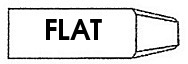


FLAT SHAPED EDGES are fully-finished and machined to a 90° profile. This is often used for desktop and tabletop glass. All sharpness, as well as flares and wavers, have been removed.
  • FLAT GROUND EDGE (often abbreviated FGE) refers to a matte or satin finish.
  • FLAT POLISHED EDGE (often abbreviated FPE) refers to a fully polished glossy edge.


PENCIL SHAPED EDGES are fully-finished and machined to a curved or arced profile. This is often used for thick desktop and tabletop glass. All sharpness, as well as flares and wavers, have been removed.
  • PENCIL GROUND EDGE (often abbreviated PGE) refers to a matte or satin finish.
  • PENCIL POLISHED EDGE (often abbreviated PPE) refers to a fully polished glossy edge.
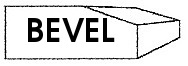

BEVELLED EDGES are sloped polished edges, often seen in mirrors. They are also sometimes seen in the glass inserts in coffee tables. Bevel width can be between 1/2″ and 1-1/4″.


FLAT v. PENCIL: What's right for you?
The difference between a flat-treated edge and a pencil-treated edge is largely one of cosmetics, and is a matter of personal preference. On thick glass — particularly 3/8″ and thicker — a pencilled edge (particularly pencil polished) looks quite striking, while on thinner glass the visual difference between flat and pencil profiles is quite subtle.

POLISHED v. GROUND EDGES: What's right for you?
If you’re using a glass top for a table or desk, the color of the wood surface will affect which edge finish will look best. A ground edge looks best on light-colored surfaces, and a polished edge looks best on dark-colored surfaces.

IS A BEVELLED EDGE SAFER?
All fully-finished glass edges,including bevelled edges, are safe for handling. A bevelled edge is decorative feature, and is more often seen on mirrors than on desktop glass. It gives the glass/mirror a “framed” appearance, by creating a sort of border-line around the perimeter.

EDGEWORK COST?
The cost of all glass & mirror edgework is directly related to complexity and time involved. The edge types described above are roughly in order of increasing cost. A ground edge is, in general, less expansive than a polished edge. Edgework done on straight edges is machined, and is considerably cheaper than edgework done on curved edges, as these must be done by hand.


DUBBED CORNERS have just the point of the corner quickly sanded off.

NIPPED CORNERS are a very slight angle, and can be thought of as large dubbed corners or small angled corners (see video).

ANGLED CORNERS are straight corner cuts. They are usually 45° angles, but do not have to be. Their size is determined by specifying the measurement of the cutback along each side.

RADIUS CORNERS are rounded corners, representing 1/4 of a circle whose radius is used to define the corner. For example, a 3/8″ radius produces a corner that is quite close to a U.S. dime coin; hence, it’s often called a 10¢ corner. Similarly, a 1/2″ radius produces a corner that is quite close to a U.S. quarter coin; hence, it’s often called a 25¢ corner.

Wednesday, November 9, 2011

TYPES OF SCREEN MATERIAL


Screens let in air & keep bugs out — in general. You may have imagined that screen mesh — the woven stuff stretched into a screen frame — is a rather singular affair, and that you didn’t have many options for what type of mesh you could use. As it turns out, there are lots of options!

FIBERGLASS MESH

Fiberglass mesh is composed of vinyl-coated fibreglass threads, and comes in grey and charcoal colors. This is the most common type of mesh used in window and patio door screens because it’s the cheapest type, it’s easy to work with, and it lays flat and smooth. However, it tends to degrade over time, particularly when exposed to direct sunlight. It’s also easily torn, so birds and pets can wreak havoc on it.
  • Fiberglass mesh PROS: inexpensive, easy to work with, smooth
  • Fiberglass mesh CONS: easily torn, tends to degrade over time

ALUMINUM MESH

Aluminum wire mesh is fairly common as well, and is used where added durability is desired vs. fibreglass mesh. It’s fairly inexpensive, but can be a bit more difficult to work with, since it shows dents or creases if bent. These dents and creases can also show up in daily use if the screen is pushed or bumped.
  • Aluminum mesh PROS: durable, inexpensive
  • Aluminum mesh CONS: difficult to work with, shows creases

PET RESISTANT MESH

Sometimes pets can be harsh on screen doors. Fibreglass mesh in particular is fairly easily torn by animal claws, and even aluminum mesh can be torn by a larger dog. For such cases, pet-resistant mesh is available to resist tearing. These are composed of vinyl-coated polyester strands. The strands are much thicker/heavier than the strands in fibreglass and aluminum mesh, and are up to 7 time stronger. Because it’s a heavier mesh, it blocks more light and visibility than standard mesh.
  • Pet resistant mesh PROS: very tear resistant, long-lasting
  • Pet resistant mesh CONS: can be expensive

SHADE/SOLAR MESH

Sometimes a screen is needed to block light, often to reduce glare or cut down solar heat gain in sunny conditions. There are many different types and grades of shade screen mesh, but all involve a densely-woven mesh that blocks anywhere from 50% to 90% of light. They are similar in feel to fibreglass mesh, and so are fairly easy to work with, but tend to be quite expensive.
  • Shade mesh PROS: reduces glare and lights, easy to work with
  • Shade mesh CONS: expensive, degrades faster than aluminum mesh

HIGH TRANSPARENCY MESH

Highly-transparent screen mesh is available when more “see-through” screens are needed. These meshes involve much thinner strands in the weave, and tend to be rather fragile, as well as being more expensive than standard meshes.
  • High transparency mesh PROS: very transparent
  • High transparency mesh CONS: fragile, expensive

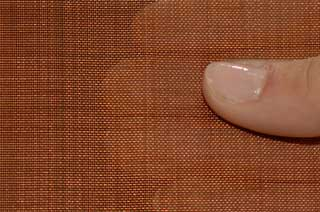
STEEL, COPPER, GALVANIZED, ETC…

Other screen meshes are available in brass, bronze, steel, copper, and many other materials. These tend to be used in commercial applications where particular strength and chemical resistance qualities are needed. They are uncommon in residential applications.

MESH DENSITY

Screen mesh is made in a variety of weave densities. The tighter the weave, the more strands there are per inch, and thus the smaller are the holes in the mesh. Most standard insect mesh has around 12-18 strands per inch. This will keep out most typical insects, such as flies and mosquitos. Where smaller insects are a problem, meshes can be used which are up to 200 strands per inch! As you’d expect, these meshes tend to be less transparent, and more costly, than standard meshes.