Showing posts with label glass. Show all posts

Tuesday, February 14, 2012

HOW WINDOW EFFICIENCY WORKS


To the right you can see a window efficiency rating sticker from the National Fenestration Rating Council (NFRC). It's a sticker you should see on every new window, though sometimes, the actual ratings will vary a bit. Let's look at the ratings provided, and what they mean:

U-FACTOR (U.S./I-P): Lower = Better

Possibly the most common rating factor is U-Factor (sometimes called "U-Value"). It measures how well the window prevents heat from escaping, and lower numbers are better. The lower the U-value, the better a window resists heat flow, so the better its insulating value. U-Factor ratings generally fall between 0.20 and 1.20. Most windows considered "energy efficient" will have a U-Factor of 0.30 or lower.

SOLAR HEAT GAIN COEFFICIENT: Lower = Better

Another fairly common rating factor is Solar Heat Gain Coefficient (SHGC). It measures how well a product blocks heat caused by sunlight. As with U-Factor, lower numbers are better. SHGC is always a number between 0 and 1, and the lower the number the less solar heat it allows into the house.

VISIBLE TRANSMITTANCE: Higher = Better

Visible Transmittance (VT) measures how much visible light comes through a window, and it's expressed as a number between 0 and 1. Unlike U-Factor and SHGC, higher numbers are better when it comes to VT, because it means the window is clearer. Because U-Factor and SHGC are improved by adding physical coatings to the glass in windows, improving those numbers generally decreases VT. As such, window efficiency is a sort of balancing game between improving energy efficiency while keeping windows as clear as possible.

AIR LEAKAGE: Lower = Better

Air Leakage (AL) indicates how much air can pass through a window, and as you'd expect, less (i.e. lower number) is better. The actual AL rating indicates the cubic feet of air passing through a square foot of window area, which leaks through cracks in the window assembly. The lower the AL, the less air will pass through cracks in the window assembly.

CONDENSATION RESISTANCE

Condensation Resistance (CR) measures the ability of a product to resist the formation of condensation on the interior surface of that product. The higher the CR rating, the better that product is at resisting condensation formation. While this rating cannot predict condensation, it can provide a credible method of comparing the potential of various products for condensation formation. CR is expressed as a number between 0 and 100.

GLASS EDGE AND CORNER OPTIONS

The type of glass edgework that’s right for you depends on how your glass will be used, any surfaces on which it may be resting, & what appearance you like. The video below shows several types of edges and corners, and descriptions after the video provide additional information.


CLEAN CUT EDGES (often abbreviated CCE) are raw, unfinished cut glass edges; i.e. they’re sharp. Because it is an unfinished edge, thicker glass will likely show wavers or flares.

SEAMED or SWIPED EDGES have the sharpness of the cut edge removed, but are still unfinished, so they’ll show wavers & flares (particularly in glass 1/4″ and thicker). Seaming/swiping is done strictly a safety measure, to make cut glass easier to handle. It is recommended for use when the glass edge will be fully concealed after installation.


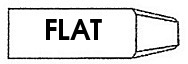
FLAT SHAPED EDGES are fully-finished and machined to a 90° profile. This is often used for desktop and tabletop glass. All sharpness, as well as flares and wavers, have been removed.
  • FLAT GROUND EDGE (often abbreviated FGE) refers to a matte or satin finish.
  • FLAT POLISHED EDGE (often abbreviated FPE) refers to a fully polished glossy edge.


PENCIL SHAPED EDGES are fully-finished and machined to a curved or arced profile. This is often used for thick desktop and tabletop glass. All sharpness, as well as flares and wavers, have been removed.
  • PENCIL GROUND EDGE (often abbreviated PGE) refers to a matte or satin finish.
  • PENCIL POLISHED EDGE (often abbreviated PPE) refers to a fully polished glossy edge.


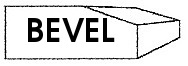
BEVELLED EDGES are sloped polished edges, often seen in mirrors. They are also sometimes seen in the glass inserts in coffee tables. Bevel width can be between 1/2″ and 1-1/4″.


FLAT v. PENCIL: What's right for you?
The difference between a flat-treated edge and a pencil-treated edge is largely one of cosmetics, and is a matter of personal preference. On thick glass — particularly 3/8″ and thicker — a pencilled edge (particularly pencil polished) looks quite striking, while on thinner glass the visual difference between flat and pencil profiles is quite subtle.

POLISHED v. GROUND EDGES: What's right for you?
If you’re using a glass top for a table or desk, the color of the wood surface will affect which edge finish will look best. A ground edge looks best on light-colored surfaces, and a polished edge looks best on dark-colored surfaces.

IS A BEVELLED EDGE SAFER?
All fully-finished glass edges,including bevelled edges, are safe for handling. A bevelled edge is decorative feature, and is more often seen on mirrors than on desktop glass. It gives the glass/mirror a “framed” appearance, by creating a sort of border-line around the perimeter.

EDGEWORK COST?
The cost of all glass & mirror edgework is directly related to complexity and time involved. The edge types described above are roughly in order of increasing cost. A ground edge is, in general, less expansive than a polished edge. Edgework done on straight edges is machined, and is considerably cheaper than edgework done on curved edges, as these must be done by hand.


DUBBED CORNERS have just the point of the corner quickly sanded off.

NIPPED CORNERS are a very slight angle, and can be thought of as large dubbed corners or small angled corners (see video).

ANGLED CORNERS are straight corner cuts. They are usually 45° angles, but do not have to be. Their size is determined by specifying the measurement of the cutback along each side.

RADIUS CORNERS are rounded corners, representing 1/4 of a circle whose radius is used to define the corner. For example, a 3/8″ radius produces a corner that is quite close to a U.S. dime coin; hence, it’s often called a 10¢ corner. Similarly, a 1/2″ radius produces a corner that is quite close to a U.S. quarter coin; hence, it’s often called a 25¢ corner.

Wednesday, November 9, 2011

BROKEN GLASS: SAFETY TIPS FOR CLEANING UP AND TRANSPORTING BROKEN GLASS

Dealing with broken glass can be scary, but it doesn’t need to be dangerous. These tips are designed to help you remain safe when you find yourself dealing with broken glass. Safety should always be your first concern, and you should never attempt any work with which you feel uncomfortable, regardless of advice given here or elsewhere.This article cannot cover every conceivable situation you may encounter, and the advice herein should never replace professional assistance when it is needed! –Contact us for help.

CLEANING UP BROKEN GLASS:

  • Clear the room of pets or small children.
  • Wear a heavy long-sleeve shirt to protect your arms.
  • Use heavy gloves to remove & discard large loose pieces of glass.
  • Do not attempt to pull out large pieces that are still attached.
  • Clean up small pieces and fragments with a shop vacuum or broom & dustpan.

TRANSPORTING GLASS TO ATKINSON’S FOR REPAIR:

  • If you’re transporting a window sash, insulated unit, storm frame, or other item with broken glass in it, use packing or duct tape to secure loose pieces.
  • Do not attempt pull out any pieces that are still attached!
  • If you are able, place the pieces you’re bringing into a cardboard box for transport. You can also use cardboard, towels, or other sturdy material to wrap the pieces.
  • Bring any & all pieces/parts you find, even if you’re not sure what they are.
  • Don’t assume your glass or window is a “standard” size. Very little is “standard” in the glass business.

GETTING YOUR NEW / REPAIRED GLASS HOME SAFELY:

  • MEASURE your vehicle carefully & thoroughly to be sure your glass will fit. It is difficult to accurately “eyeball” glass size. THIS IS VERY IMPORTANT!
  • SUPPORT: Glass should ideally be transported on edge, with plenty of side support to make sure it stays upright. If it is to be transported laying flat, be sure you provide adequate support under its entire surface. A piece of plywood cut to the size of the glass is an ideal form of support.
  • HAZARDS: Remove all objects from the area your glass will be placed during transportation. Metal, stone, and other hard objects and surfaces should be removed from the area.
  • PETS: It’s best to leave pets at home when picking up glass. Their excitement about your new purchase may be understandable, but their safety is important, and claws can scratch new glass.
  • DELIVERY: If you don’t feel comfortable transporting your glass, please consider having us deliver it for you. The extra cost may be well worth the peace of mind! — Contact us for help.